Monday, March 12, 2018

Weekly Blog 3/5 - 3/9

Image Source:
https://www.stevespanglerscience.com/lab/experiments/pop-bottle-sounds/

Summary:
Sound can be affected by all matter such as liquid, solid, or gas. Such as blowing into a bottle. The more water the bottle has the more high pitched the blowing will be. But this is different when hitting the bottle. When the water level is higher the pitch is lower.

S&EP:
SP2: Developing and using models
This week we did a lab where we had a line of bottles in terms of water level. We then blew and hit each one to see what would happen. This is SP2: Developing and using models because we used a model to show how sound works when there is other matter with it.

Friday, March 2, 2018

Music WAC


Music is a big thing in our lives today from listening to the radio while driving to listening while do your work. Music is everywhere. But music can also be a big issue with kids which can lead them to get distracted to other important tasks. It can become a bigger distraction then a helpful source. In my opinion kids shouldn’t listen to music while working. Here’s three reasons why.

Listening to music damages your performance on your tasks. According to the article by Sarah Briggs it states according to some new research music can damage your performance on other tasks. They had 25 people listen to 5 types of music: quiet, music that they liked, music that they didn’t like, voice repeating number 3, and a voice reciting random numbers as they try to remember a stream of random letters. The results showed that they did the best at remembering while it was quiet and when there was the voice repeating the number 3. This is strong evidence that music damages your performance on you tasks at hand.


The lyrics and notes in music you listen to disrupt your ability to focus on what you’re doing. According to the article by Sarah Briggs it states, “Music may impair cognitive abilities things in order, because you may get thrown off by the changing words and notes in your chosen song. That’s why they have dubbed this phenomenon the ‘irrelevant sound effect’ (ISE).” This shows that music throws you off with different notes and lyrics which can take your mind off of your task at hand. The article also states: “They did the best in the quiet and while listening to the repeated three.” This shows that you can remember things better and get things done if there is quiet or when the music you listen to is predictable.


Music can help you focus and help you with research. There have been studies where it shows that music can help with the brain. Sarah Briggs mentions a study from 2007 where they had people listen to 18th century music. It showed many benefits for the brain in the areas where paying attention, making predictions, and updating the event in memory are important. But most importantly, "...peak brain activity occurred during a short period of silence between musical movements..." This is evidence for the other side that listening to music can help the brain however this information isn’t consistent. But one strong piece of evidence is when peak brain activity was when nothing was happening. This is further evidence that you shouldn’t listen to music while studying.

Furthermore, you shouldn’t listen to music while studying. First, music damages your performance to other tasks at hand. Second, all the lyrics and notes in the music you listen to throws you off while studying making it harder. Finally, in the article by Sarah Briggs it shows strong evidence that peak brain activity occurred when seemingly nothing was happening. In conclusion, listening to music while studying takes your mind off other tasks, throws you off, and makes it harder to study.


Sunday, February 11, 2018

Roller Coaster Project Blog


Summary:
The roller coaster project is a project where you build a roller coaster of your liking and use it as an example of your learning of motion. There are many aspects of motion that your roller coaster can have. Like when you drop it from the tall hill it has the greatest potential energy. And how kinetic energy is turned into potential energy as it reaches the height of the loop. 

Backward-Looking:
What process did you go through to produce this piece?
We had to simulate the loops and turns before we taped the actual supports to the track. We would then tape together the supports and track but not secure it to the base because we didn't have the hot glue. The next day we hot glued the supports to the base, securing the track. We then went through decorating the track to make it look nicer and labeling spots of highest potential energy, kinetic energy, etc.

Inward-Looking:
How do you feel about this piece of work? What parts of it do you particularly like? Dislike? Why? What did/do you enjoy about this piece or work?
I feel proud of our roller coaster since we put a lot of effort into it with supports, track, and decorating. I enjoyed assembling the track and supports and especially decorating. There was no real part of this project that I really disliked. I enjoyed the whole project overall. The part I enjoyed most was decorating and testing the roller coaster.

Outward-Looking:
What grade would you give it? Why?
I would give it an A. I would give it this grade since we had put a lot of effort into this project with work and decorating. I believe we did a good job overall with the finished product. There were some small things that were a bit off but weren't too serious.  One such small problem was the low walls at the sharp turn.

Forward-Looking:
What would you like to spend more time on in school?
What I would like to spend more time on in school more decorating time. We spent most of our time on building the roller coaster so we had only 1 1/2 class periods to work on decorations. We decorated a bit but the hill area was a bit empty of decorations. If we got more time I would focus on decorating that area a little bit more to give it more life.

Sunday, February 4, 2018

Weekly Blog 1/29 - 2/2


Image Source:
http://www.novasom.us/newtons-three-laws-2/

Summary:
Newton's three laws apply to motion. The first law states that objects tend to keep doing what they are already doing. The second law states the more mass something has the more force is required for it to accelerate at a constant rate. The third law states for every action there is a reaction. These laws apply to everything from a still rock to a rocket blasting off into the atmosphere.

S&EP:
SP2: Developing and using models
This week I worked on a document about Newton's three laws. Many of these in the document were real-life scenarios which were the models I used to visualize in my head. This is SP2: Developing and using models because I used the real-life scenarios to visualize it in my head.

Sunday, January 28, 2018

Weekly Blog 1/22 - 1/26

Image Source:
http://problemsplitter.com/moodle/pluginfile.php/1649/course/overviewfiles/force%20icon.PNG

Summary:
A force can be seen as a push or pull of something. Some examples include the pull of gravity, the push you apply to a ball, etc. There are many different forces. For example, balanced force, unbalanced force, combined forces, etc. If there was a box still on a table that wouldn't mean just no force. That would mean there is an equal force on all sides making it stay still.

S&EP:
SP2: Developing and using models
This week I worked on a document about forces. We had to use a model multiple times to see what would happen with balanced and unbalanced force. This is SP2: Developing and using models because I used a model to see how forces work.


Sunday, January 21, 2018

Weekly Blog 1-17 - 1-19

Image Source:
https://www.khanacademy.org/science/physics/one-dimensional-motion/acceleration-tutorial/a/acceleration-article

Summary:
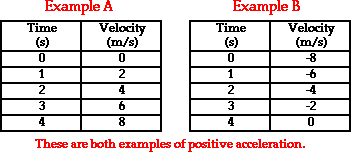
Acceleration is a change of velocity in an amount of time. One example of this is 10 miles per hour to 20 miles per hour. You can find acceleration everywhere from falling objects to the little toy cars you played with as a kid. You can put this on graphs although it depends on what type of graph you're using if you want to put a straight line for acceleration on your graph.

S&EP:
SP3: Planning and carrying out investigations
This week I and my team worked with a hot wheels lab trying to find the acceleration with different heights and stuff. This is SP3: Planning and carrying out investigations because we did an experiment to find this information and data.


Sunday, January 14, 2018

Weekly Blog 1/8 - 1/12


Image Source:
http://www.physicsclassroom.com/Class/1DKin/U1L1e6.gif

Summary:
Acceleration is the change of velocity over time. Acceleration is usually shown as a curving line going upwards towards the top right corner. Deacceleration is shown as a curving line going downwards towards the bottom right corner. It could also be shown as a straight line if the graph has speed as the y-axis and time as the x-axis.

S&EP:
SP4: Analyzing and interpreting data
This week I worked on an acceleration document and a lab about acceleration. This is SP4: Analyzing and interpreting data because there was data there that I examined and found out which parts of the graph were an example of acceleration and what parts were a constant speed. That is how I performed SP4: Analyzing and interpreting data this week.